
Latos Data Centres is proposing a new AI-ready data centre in East Manchester.

WELCOME

Our vision is to deliver vital digital infrastructure that supports Manchester’s continued economic growth, strengthens its position as a leading technology hub, and helps future-proof the city for the next generation of digital services and artificial intelligence.
Located close to the Lowry Park industrial area, the proposed development site is on the corner of Bower Street and Ten Acres Lane, next to the Rochdale Canal, and is currently vacant.
Our proposals would bring this brownfield site back into active use and represent a major investment in the local area.
A planning application has now been submitted to Manchester City Council.
The application has been validated by the Council under reference PLA-2026-001350. You can view the submitted plans and documents on Manchester City Council’s planning portal or by clicking here.

About us
Founded in 2021, Latos Data Centres is focused on delivering sustainable, high-performance data centre infrastructure to meet growing demand.
We combine cutting-edge data centre design with a strong commitment to environmental responsibility. Through the use of green energy, a focus on carbon neutrality, and environmentally conscious practices at every stage, we are dedicated to supporting digital growth while safeguarding the health of our planet.
Our first UK data centre is being built in Stockton-on-Tees: a £100 million state-of-the-art facility providing game-changing AI capabilities and full data sovereignty. We expect this to open in late 2027.
Alongside this, we are progressing plans for a further 35 sites across the UK, including our proposal for Bower Street.
You can find out more about us via the Latos Data Centres website at www.latosdc.co.uk.
What is a data centre?
Data centres are the secure physical facilities that store, process and run large amounts of data and software which power everyday online services, from banking and streaming to cloud storage and AI tools.
Many of us interact with a data centre hundreds of times of day, such as when we make a bank transaction, stream a film or video game, shop online, send emails and texts, or use an app to control our central heating. Every time someone saves a photo or document to the cloud, it is being stored in a data centre.
As Manchester’s digital and technology sectors continue to expand, resilient, locally based digital infrastructure is increasingly important.

Supporting growth
This development will bring significant benefits to Greater Manchester and the local area. By regenerating a vacant brownfield site, creating jobs, and providing modern, sustainable digital infrastructure, the project will support the local community, strengthen the regional economy, and help future-proof the city.
Local benefits

High-quality design
Well-designed buildings, alongside enhanced landscaping and planting around the site will help improve the look and feel of the site and the surrounding area, including the canalside environment.

Regenerating brownfield land
Bringing a vacant brownfield site back into active use, supporting regeneration in the area and avoiding development on greenfield land.

Jobs and investment
Creating construction jobs and long-term roles, alongside significant investment in the local area.

Low-impact development
Once operational, the data centre will generate low traffic and minimal day-to-day activity.
Benefits for Greater Manchester

Supporting the digital economy
Providing critical digital infrastructure that supports everyday online services and enables Manchester’s growing community of digital, creative and technology businesses to operate, scale and compete nationally and internationally.

Secure and resilient data
Keeping data stored securely in the UK and improving digital resilience across Greater Manchester.

Boosting regional growth
Helping to attract inward investment, support innovation and create high-value employment in the region.

Future-ready infrastructure
Supporting the continued growth of cloud computing, artificial intelligence and data-driven services, helping ensure Manchester has the infrastructure needed to support emerging technologies and future digital demand.
LATOS MANCHESTER EAST
Our proposals
Latos’ new Manchester Data Centre would be a Neural Edge Data Centre – a new type of facility designed to handle the fast-growing demand for digital services and artificial intelligence.
Neural Edge data centres are designed to be compact, efficient and future-ready, delivering high performance without unnecessary scale. They are carefully engineered to bring computing power closer to where it is needed, helping digital services run faster and more smoothly.
The design also places a strong emphasis on energy efficiency, using intelligent cooling and modern technology to reduce energy use while maintaining high performance standards.
Planted façades and screening
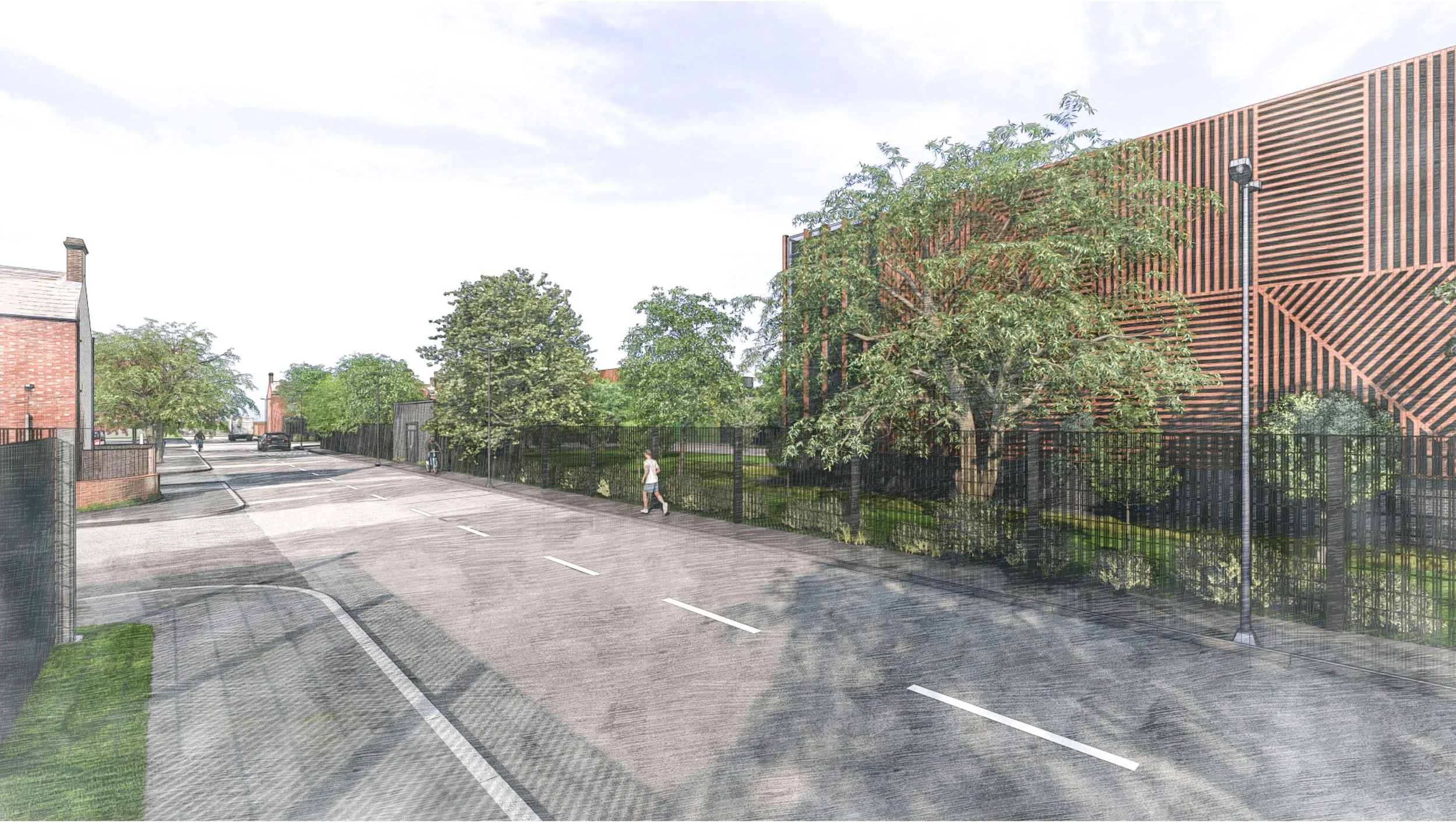
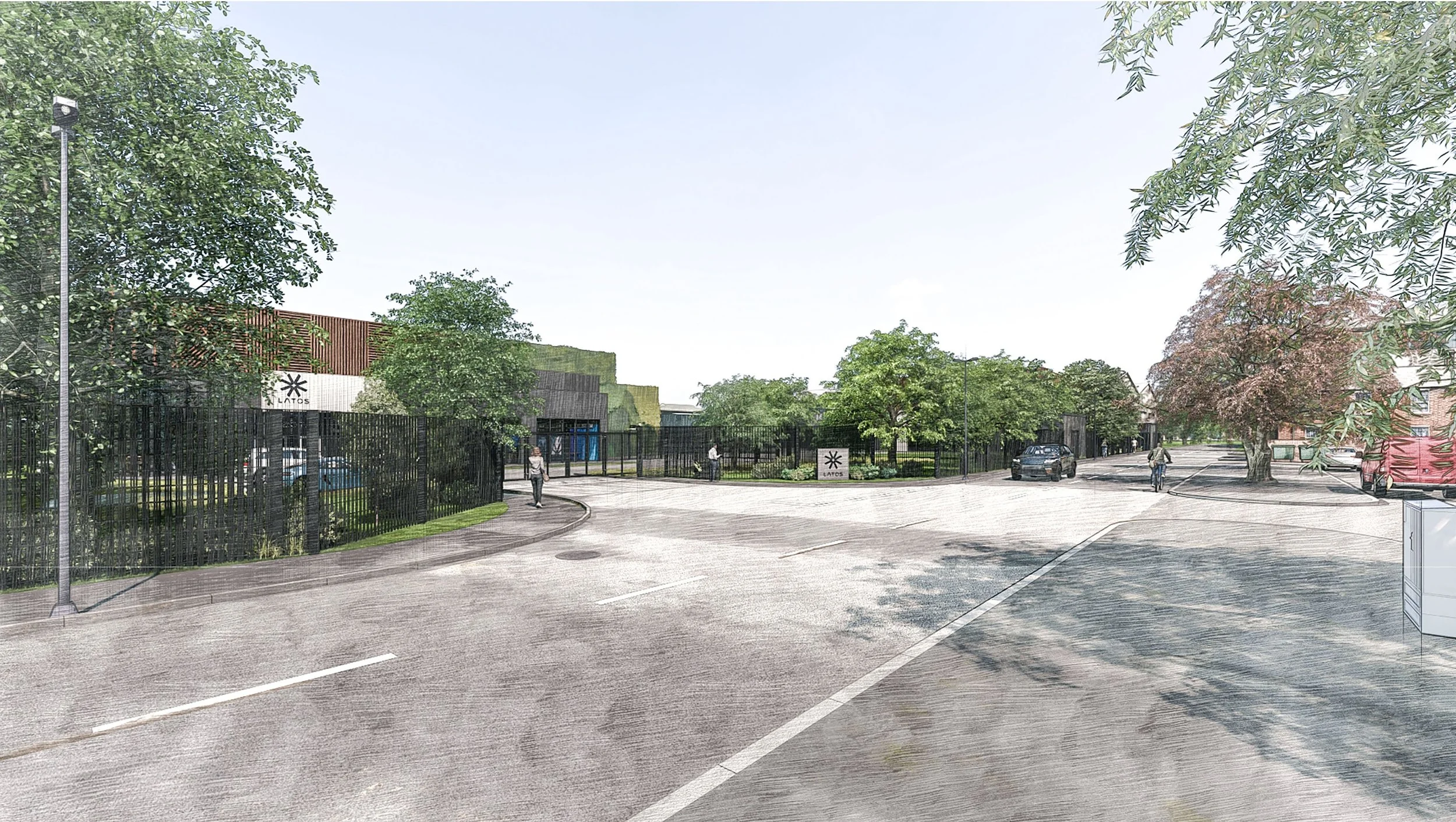
Planted façades will screen plant and service areas, softening the appearance of the buildings and providing a visual buffer to nearby homes and the canal-side environment.
High-quality materials
Brick at street level and glazed elements to create a solid, high-quality and welcoming appearance.
Sensitive site layout
Data halls positioned furthest from existing homes to minimise noise impacts.
Landscape-led approach
Retaining mature boundary trees and planting approximately 120 new native trees to strengthen screening and enhance biodiversity.
Two-building layout
Arranged across two buildings to allow daylight through the site and ensure the development does not feel overbearing.
Perimeter security
Fencing provided around the full perimeter of the site.
Health and safety standards
Designed to meet strict health and safety regulations, with a robust fire safety strategy in place.
Sustainable design
Environmental considerations built into the design, with energy efficiency, sustainable drainage and biodiversity as key priorities.
Low-impact operation
A relatively small number of staff on a day-to-day basis, resulting in very low traffic once operational.
Your questions answered
-
An operational data centre is not completely silent, but noise levels are expected to be at or below typical background noise levels. We have positioned the buildings within the site so that they are furthest away from the neighbouring homes. Measures such as acoustic fencing and the landscape buffer will help to further protect neighbouring residents.
Specialist noise consultants are undertaking detailed assessments to ensure the scheme complies fully with Manchester City Council’s requirements.
-
Next-generation data centres are designed to minimise their need for water. The facility will use a modern closed-loop cooling system, where water is recirculated rather than constantly drawn from the mains supply.
-
The data centre will connect directly to the grid via new, dedicated substations. It will not take electricity from the local residential supply. This means the development will not reduce electricity available to local residents or increase the risk of power cuts. The connection will be agreed with the network operator to ensure there is sufficient capacity and that local supply remains secure and reliable.
-
Data centres typically require a relatively small number of staff on a day-to-day basis. As a result, once operational, there would be a very small amount of traffic associated with the facility.
-
Data centres are designed to meet strict health and safety regulations and often present a lower risk than many traditional industrial or factory uses.
The facility will incorporate a robust fire safety strategy, including comprehensive fire detection and suppression systems both inside and outside the buildings. Site security will also be very robust, including perimeter fencing and CCTV.
-
If planning permission is granted, construction is expected to take around 18 months.
A Construction Management Plan would be put in place to manage working hours, deliveries, noise, dust and site access, helping to reduce disruption to local residents.
Community Consultation
During the consultation, which closed on Monday 16 March 2026, members of the community were invited to learn more about the proposals, speak with the project team and share their views. We would like to thank everyone who took the time to take part and provide feedback.
Following consideration of the feedback received during consultation, a planning application was submitted to Manchester City Council.
The application has been validated under reference PLA-2026-001350. The submitted plans and documents can be viewed on Manchester City Council’s planning portal or by clicking here.
Our dedicated communication channels remain open should anyone wish to get in touch with the project team.